Friday, December 08, 2006
Howlin' Wolf
Producer Sam Phillips said upon first hearing Howlin' Wolf's music: "This is for me. This is where the soul of man never dies."


Thursday, November 30, 2006
Seas of the Mind
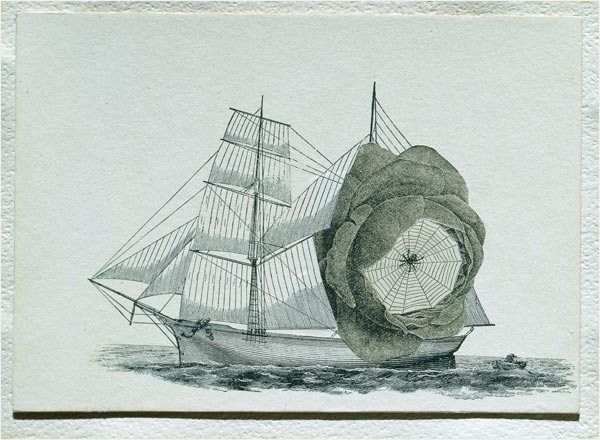
Joseph Cornell's early collage Untitled (Schooner) is a remarkable image hinting at his later masterful (and slightly precious) handmade box collage creations using junk and ephemera gathered from his wanderings among junk and old book stores in Manhattan.
It recalls a piece by Tennessee artist Andrew Saftel, a mixed media sculpture called Past Away. Another mysterious creation hinting at the child-like desire to explore one's dreams on a boat made by whatever materials are on-hand.

Or Saftel's ship could be Sir Francis Drake's galleon discovered in the middle of the jungle by Jose Arcadio Buendia in Gabriel Garcia Marquez's circular time narrative One Hundred Years of Solitude. Marquez is also creating by using the materials on-hand by using the Drake galleon as a way to re-create his home in the dreamland of One Hundred Years of Solitude.
Monday, November 20, 2006
Deep Blues
W.C. Handy first heard the blues on a train platform in Tutwiler, MS in 1903. Handy called it the "weirdest music I had ever heard." He heard a mysterious man accompany himself on the guitar and repeat the line "Goin' where the Southern cross the Yellow Dog." South of Tutwiler, the tracks of the Yazoo & Mississippi Valley Railroad - known as the Yellow Dog - crosses the tracks of the Southern in Moorehead (modern photos here). All this can be found in Robert Palmer's book Deep Blues.
In 1966, Bob Dylan recorded "Absolutely Sweet Marie" in Nashville and released on Blonde on Blonde. This song includes the line: "And now I stand here looking at your yellow railroad / In the ruins of your balcony." A line that Dylan once said was "not a lie."
In 2006, Dylan recorded the song "Nettie Moore" and released it on Modern Times. It includes the line: "I've gone where the Southern crosses the Yellow Dog / Get away from all these demagogues."
Yellow railroads, yellow dogs and lots of weird music.
In 1966, Bob Dylan recorded "Absolutely Sweet Marie" in Nashville and released on Blonde on Blonde. This song includes the line: "And now I stand here looking at your yellow railroad / In the ruins of your balcony." A line that Dylan once said was "not a lie."
In 2006, Dylan recorded the song "Nettie Moore" and released it on Modern Times. It includes the line: "I've gone where the Southern crosses the Yellow Dog / Get away from all these demagogues."
Yellow railroads, yellow dogs and lots of weird music.
Wednesday, October 11, 2006
Dead Snake
The following quotation by Stephen Crane was found in a Luc Sante piece in the New York Review of Books:
"An artist, I think, is nothing but a powerful memory that can move itself through certain experiences sideways and every artist must be in some things powerless as a dead snake."
A line filled with mystery and force. The image of the snake in the second half of the sentence coils back to the first half as one envisions an artist moving sideways snake-like through collected memories sorting motivations and impulses while lacking the ability to change outcomes or determinations of a lifeless reptile.
Sante says that this line from Crane is quoted by John Berryman.
"An artist, I think, is nothing but a powerful memory that can move itself through certain experiences sideways and every artist must be in some things powerless as a dead snake."
A line filled with mystery and force. The image of the snake in the second half of the sentence coils back to the first half as one envisions an artist moving sideways snake-like through collected memories sorting motivations and impulses while lacking the ability to change outcomes or determinations of a lifeless reptile.
Sante says that this line from Crane is quoted by John Berryman.
Monday, October 02, 2006
Two Up
Two recent music purchases: John Coltrane's One Up, One Down: Live at the Half Note and Yo La Tengo's I Am Not Afraid of You and I Will Beat Your Ass (the title supposedly comes from a comment from Knick Kurt Thomas to fellow Knick and all-around prick Stephon Marbury). The Coltrane set is phenomenal especially the title track. 27 minutes long, Coltrane and drummer Elvin Jones (Best. Drummer. Ever.) engage on an extended duet that find both stretching towards the heavens like two half-crazed prophets. The recordings come from a radio broadcast that only provide a snippet of the actual set and realizing that the 27 minute-long song is actually 45 minutes in length in the actual performance. That's a pretty good sermon length.
Yo La Tengo's latest disc finds the band returning to their find-the-influence game shifting from extended feedback-driven guitar workout to white man soul. Many found their last record Summer Sun to be too singular in sound, so this hodgepodge collection may be a response. On first listen, the energy is there and the songwriting is as strong as ever. There are a few clinkers, but most of all, a celebration on the joy of creating music. (Download two samples here.)
Yo La Tengo's latest disc finds the band returning to their find-the-influence game shifting from extended feedback-driven guitar workout to white man soul. Many found their last record Summer Sun to be too singular in sound, so this hodgepodge collection may be a response. On first listen, the energy is there and the songwriting is as strong as ever. There are a few clinkers, but most of all, a celebration on the joy of creating music. (Download two samples here.)
Friday, September 22, 2006
Thursday, September 14, 2006
Dawg Kickin'
In 1967, Bob Dylan had retreated from public life to family life in Woodstock, NY. Living out his dreams of a house, wife, kids and a white picket fence, Dylan still had time for music. With The Band, he recorded a body of music called The Basement Tapes filled with sea chanteys, rockabilly rave-ups, chain gang songs, traditional folk tunes, Chicago blues, original songs and all things in between. The music and legacy of The Basement Tapes have been thoroughly examined in a number of places especially Greil Marcus’s Invisible Republic.
One song that always stood out was “You Gotta Quit Kickin’ My Dog” around (download here). You can hear Dylan start to show The Band how to play the song and they latch onto it and create a wild and hilarious call-and-response tune. It’s almost a shaggy dog story as the singer becomes less concerned about his poor dog than about telling his friends about it.
This performance is both ridiculous and compelling. The history of this song is just as compelling and ridiculous. From one internet source:
"According to Alan Lomax: Some say 'The Hound Dawg Song,' a favourite Ozark mountain song, originated before the Civil War, when a country boy named Zeke Parish had a tussle with a townie, who had kicked his dog. Old Aaron Weatherman, Swan Post Office, Taney County, Missouri, concurs -- 'I was there and knowed Zeke and his paw and the hound, too.' Some of his neighbors laugh at old Zeke and say that 'The Hound Dawg Song' is a recently composed piece, while others swear that Daniel Boone brought the song to Missouri."
The song was adopted as a theme song for Missouri Congressman James Beauchamp “Champ” Clark’s campaign for the Democratic presidential nomination in 1912. Clark went into 1912 Democratic convention with a clear lead amongst the delegates, but could never secure the two-thirds votes of the delegates necessary for nomination. Eventually, a deal was cut making Woodrow Wilson, the Democratic nominee and, with the Republican party split between Taft and Teddy Roosevelt, the presidency. No President Champ Clark. No “You Gotta Quit Kickin’ My Dog Around” playing at his inauguration.
The song was eventually recorded by Byron G. Harlan in 1912 as “They Gotta Quit Kickin’ My Dog Around” (download here) and Gid Tanner and His Skillet Lickers scored a hit with the song in 1926 as “Ya Gotta Quit Kickin’ My Dog Aroun’” (download here).
The story seemed to end here. Until last spring Bob Dylan started DJing a radio show for XM Satellite Radio called Theme Time Radio Hour, each week playing songs following a certain theme. These shows exhibit Dylan’s playful side as well as his deep love of American music playing long-forgotten songs.
On Episode 16, the theme for Dylan’s show was “Dogs,” and he played a track by Rufus Thomas. Thomas was an R&B singer based in Memphis and who recorded for the famed Stax Record label. The song is “Stop Kickin’ My Dog Around” (download here with Dylan’s commentary before and after). Rufus Thomas scored a hit in 1963 with “Walking the Dog” and followed that with many other dog songs including “Can Your Monkey Do the Dog” and “Can’t Get Away From This Dog.” Hearing Thomas’s version, you hear Dylan’s inspiration for the Basement Tapes version, especially because of the wailing background voices.
“You Gotta Quit Kickin’ My Dog” is a silly song. A ditty. A throwaway. Except that different generations of performers - black and white, urban and rural - keep finding something in it. The adventure of this song reflects the peculiarities and joy that is American music.
Every time I come to town
The boys keep kickin’ my dawg around;
Makes no difference if he is a hound,
They’ve got to quit kickin’ my dawg around.
One song that always stood out was “You Gotta Quit Kickin’ My Dog” around (download here). You can hear Dylan start to show The Band how to play the song and they latch onto it and create a wild and hilarious call-and-response tune. It’s almost a shaggy dog story as the singer becomes less concerned about his poor dog than about telling his friends about it.
This performance is both ridiculous and compelling. The history of this song is just as compelling and ridiculous. From one internet source:
"According to Alan Lomax: Some say 'The Hound Dawg Song,' a favourite Ozark mountain song, originated before the Civil War, when a country boy named Zeke Parish had a tussle with a townie, who had kicked his dog. Old Aaron Weatherman, Swan Post Office, Taney County, Missouri, concurs -- 'I was there and knowed Zeke and his paw and the hound, too.' Some of his neighbors laugh at old Zeke and say that 'The Hound Dawg Song' is a recently composed piece, while others swear that Daniel Boone brought the song to Missouri."
The song was adopted as a theme song for Missouri Congressman James Beauchamp “Champ” Clark’s campaign for the Democratic presidential nomination in 1912. Clark went into 1912 Democratic convention with a clear lead amongst the delegates, but could never secure the two-thirds votes of the delegates necessary for nomination. Eventually, a deal was cut making Woodrow Wilson, the Democratic nominee and, with the Republican party split between Taft and Teddy Roosevelt, the presidency. No President Champ Clark. No “You Gotta Quit Kickin’ My Dog Around” playing at his inauguration.
The song was eventually recorded by Byron G. Harlan in 1912 as “They Gotta Quit Kickin’ My Dog Around” (download here) and Gid Tanner and His Skillet Lickers scored a hit with the song in 1926 as “Ya Gotta Quit Kickin’ My Dog Aroun’” (download here).
The story seemed to end here. Until last spring Bob Dylan started DJing a radio show for XM Satellite Radio called Theme Time Radio Hour, each week playing songs following a certain theme. These shows exhibit Dylan’s playful side as well as his deep love of American music playing long-forgotten songs.
On Episode 16, the theme for Dylan’s show was “Dogs,” and he played a track by Rufus Thomas. Thomas was an R&B singer based in Memphis and who recorded for the famed Stax Record label. The song is “Stop Kickin’ My Dog Around” (download here with Dylan’s commentary before and after). Rufus Thomas scored a hit in 1963 with “Walking the Dog” and followed that with many other dog songs including “Can Your Monkey Do the Dog” and “Can’t Get Away From This Dog.” Hearing Thomas’s version, you hear Dylan’s inspiration for the Basement Tapes version, especially because of the wailing background voices.
“You Gotta Quit Kickin’ My Dog” is a silly song. A ditty. A throwaway. Except that different generations of performers - black and white, urban and rural - keep finding something in it. The adventure of this song reflects the peculiarities and joy that is American music.
Every time I come to town
The boys keep kickin’ my dawg around;
Makes no difference if he is a hound,
They’ve got to quit kickin’ my dawg around.
Monday, September 11, 2006
Old Weird American
Harry Smith is mostly known for as the creator and curator of the highly influential box-of-wonders, the Anthology of American Folk Music. Released in 1952, this collection of tunes from the 1920s and 30s unleashed many secret recordings by Bascombe Lamar Lunsford, Richard "Rabbit" Brown and the Masked Marvel (a pseudonym of Charley Patton's) to an American public who had mostly forgotten this other America. It's since been re-released on CD by the Smithsonian and once again reminding us about this alternative America.Harry, besides being an exhaustive collector of old records and a repository of biographical and historical knowledge about old songs and musicians, was an accomplished avant garde filmmaker. Experiementing with painting straight on to film, here's a look at some "early abstractions" of Harry's from 1946-57...
Thursday, August 31, 2006
Modern Times
Modern Times, Bob Dylan's latest work of original songs, was released on Tuesday, August 29th. Dylan's last record, Love and Theft, was released on September 11, 2001, making the apocolyptic overtones of some the lines all the more spooky. But as one critic said, when you've been singing about the ends of days for 40 years sooner or later you're going to be right.
Modern Times feels like a natural progression from Love and Theft. Both were produced by Dylan under the pseudonym Jack Frost. Unlike the sea change of tone and sound between 1997's Time Out of Mind and Love and Theft, there's nothing unexpected musically about Modern Times: Chicago blues riffs, Hoagy Carmichael chord progressions and long ballads. Modern Times was recorded with Dylan's touring band, who provide a steady and professional backing lacking some of the urgency of Love and Theft. The emphasis of the record on Dylan's singing.
Dylan's voice - mocked by clever 6th graders and 50 year old librarians alike - has evolved into quite an instrument. On "Someday Baby," Dylan occassionaly whispers lines in a higher register giving the impression that he can barely utter the words of spite: "Well you take my money and you turn it out / You fill me up with nothin' but self doubt / Someday baby, you ain't gonna worry po' me any more." Dylan has learned when to growl, when to wail, and when to whisper.
But the utter joy of Modern Times as with all of Dylan's recent material in this grand stage of his career including the memoir Chronicles is the wonderful one liners. No one writes with more wit and beauty as Bob Dylan. He's also a bit of a salty dog. A sampling:
"I got the porkchops, she got the pie / She ain't no angel and neither am I"
"They brag about your sugar / Brag about it all over town / Put some sugar in my bowl I feel like laying down."
"You think I'm over the hill / You think I'm past my prime / Let me see what you got / We can have a whoppin' good time."
"When I was young, driving was my crave / You drive me so hard, almost to the grave."
There's lots more to say about Modern Times, but listening to it after reading a few reviews, one notices how lazy and repetitive these reviewers are. Some repetitions: "Thunder on the Mountain" is a Chuck Berry-like song, the drummer uses brushes instead of sticks throughout, and Modern Times is the third part of a trilogy of records starting with Time Out of Mind and continuing through Love and Theft. All of these statements can be easily called into question, but reviewers repeat them like seagulls bleating in unison at the beach.
Modern Times feels like a natural progression from Love and Theft. Both were produced by Dylan under the pseudonym Jack Frost. Unlike the sea change of tone and sound between 1997's Time Out of Mind and Love and Theft, there's nothing unexpected musically about Modern Times: Chicago blues riffs, Hoagy Carmichael chord progressions and long ballads. Modern Times was recorded with Dylan's touring band, who provide a steady and professional backing lacking some of the urgency of Love and Theft. The emphasis of the record on Dylan's singing.
Dylan's voice - mocked by clever 6th graders and 50 year old librarians alike - has evolved into quite an instrument. On "Someday Baby," Dylan occassionaly whispers lines in a higher register giving the impression that he can barely utter the words of spite: "Well you take my money and you turn it out / You fill me up with nothin' but self doubt / Someday baby, you ain't gonna worry po' me any more." Dylan has learned when to growl, when to wail, and when to whisper.
But the utter joy of Modern Times as with all of Dylan's recent material in this grand stage of his career including the memoir Chronicles is the wonderful one liners. No one writes with more wit and beauty as Bob Dylan. He's also a bit of a salty dog. A sampling:
"I got the porkchops, she got the pie / She ain't no angel and neither am I"
"They brag about your sugar / Brag about it all over town / Put some sugar in my bowl I feel like laying down."
"You think I'm over the hill / You think I'm past my prime / Let me see what you got / We can have a whoppin' good time."
"When I was young, driving was my crave / You drive me so hard, almost to the grave."
There's lots more to say about Modern Times, but listening to it after reading a few reviews, one notices how lazy and repetitive these reviewers are. Some repetitions: "Thunder on the Mountain" is a Chuck Berry-like song, the drummer uses brushes instead of sticks throughout, and Modern Times is the third part of a trilogy of records starting with Time Out of Mind and continuing through Love and Theft. All of these statements can be easily called into question, but reviewers repeat them like seagulls bleating in unison at the beach.
Wednesday, August 30, 2006
summer reading
Asked about his summer reading, President Bush told NBC's Brian Williams: "I was in Crawford and I said I was looking for a book to read, and Laura said, 'You oughtta try Camus.' I also read three Shakespears."
Subscribe to:
Posts (Atom)